
Pakistan Ramps Up Border Defenses Amid Nipah Virus Threat: What You Need to Know
Pakistan Ramps Up Border Defenses Amid Nipah Virus Threat: What You Need to Know (What is Nipah Virus?)
NEWS
1/27/20262 min read
Pakistan Ramps Up Border Defenses Amid Nipah Virus Threat: What You Need to Know
In an era where global health security is more connected than ever, Pakistan has taken a proactive stance to protect its citizens. On Wednesday, federal authorities announced the immediate enforcement of "strict and enhanced health surveillance" across all international entry points. This move comes as a direct response to a growing regional threat: the Nipah virus (NiV).
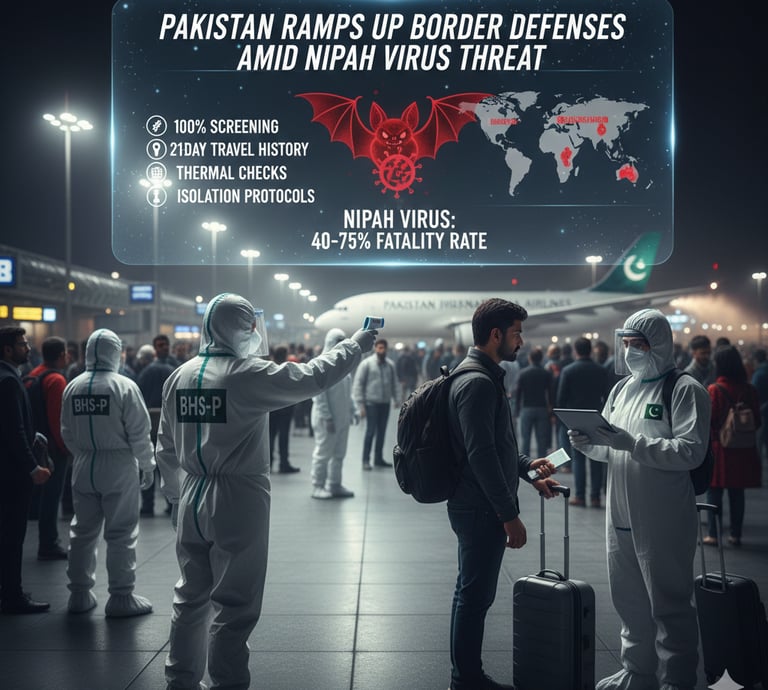
The decision, spearheaded by the Border Health Services-Pakistan (BHS-P), follows reports of confirmed cases in West Bengal, India. With a staggering fatality rate ranging from 40% to 75%, the World Health Organization (WHO) classifies Nipah as a priority pathogen—one that has the potential to spark fast-moving, deadly outbreaks.
What is Nipah Virus?
Nipah is a zoonotic virus, meaning it jumps from animals to humans. Its primary carriers are fruit bats (Pteropus genus), but it can also infect livestock like pigs. More alarmingly, the virus can spread directly between humans through close contact with bodily fluids.
Symptoms are often severe, starting with fever and headache but quickly progressing to respiratory issues and acute encephalitis (swelling of the brain), which can lead to coma or death within 24 to 48 hours. Currently, there is no approved vaccine or cure, making prevention the only viable defense.
Zero Tolerance at the Borders
The new advisory issued by the Ministry of National Health Services leaves no room for error. The instructions apply to every international airport, seaport, and land crossing in Pakistan.
Key measures include:
100% Screening: Every individual—including passengers, transit travelers, flight crews, and even cross-border truck drivers—must undergo health clearance.
21-Day Travel History: Authorities are now verifying the travel and transit history of every traveler for the preceding three weeks to identify those coming from high-risk regions.
Thermal and Clinical Assessment: Medical staff are on high alert for symptoms such as confusion, drowsiness, or respiratory distress.
Strict Isolation Protocols: Any suspected case will be immediately quarantined at the border and moved to designated tertiary care hospitals under strict infection control.
National Readiness and Public Safety
While Pakistan has not yet reported a human case of Nipah, the National Institute of Health (NIH) emphasizes that the risk of "spillover" is significant given the outbreaks in South Asia as of January 2026.
Beyond border checks, the NIH is focusing on institutional readiness. Rapid response teams are being activated, and healthcare providers are being trained on a unified framework for sample transportation and infection management. The message from the government is clear: any lapse in surveillance or negligence in following safety protocols will be treated with the utmost seriousness.
How Can You Stay Safe?
As the government does its part at the borders, public awareness is the second line of defense. Health experts recommend avoiding contact with bats or sick pigs and refraining from consuming raw date palm sap, which can be contaminated by bat secretions.
Pakistan’s swift action mirrors steps taken by other regional hubs like Singapore and Malaysia, showing a unified front against a virus that respects no borders. For now, the "dark night" of this health threat is being met with a wall of vigilance.